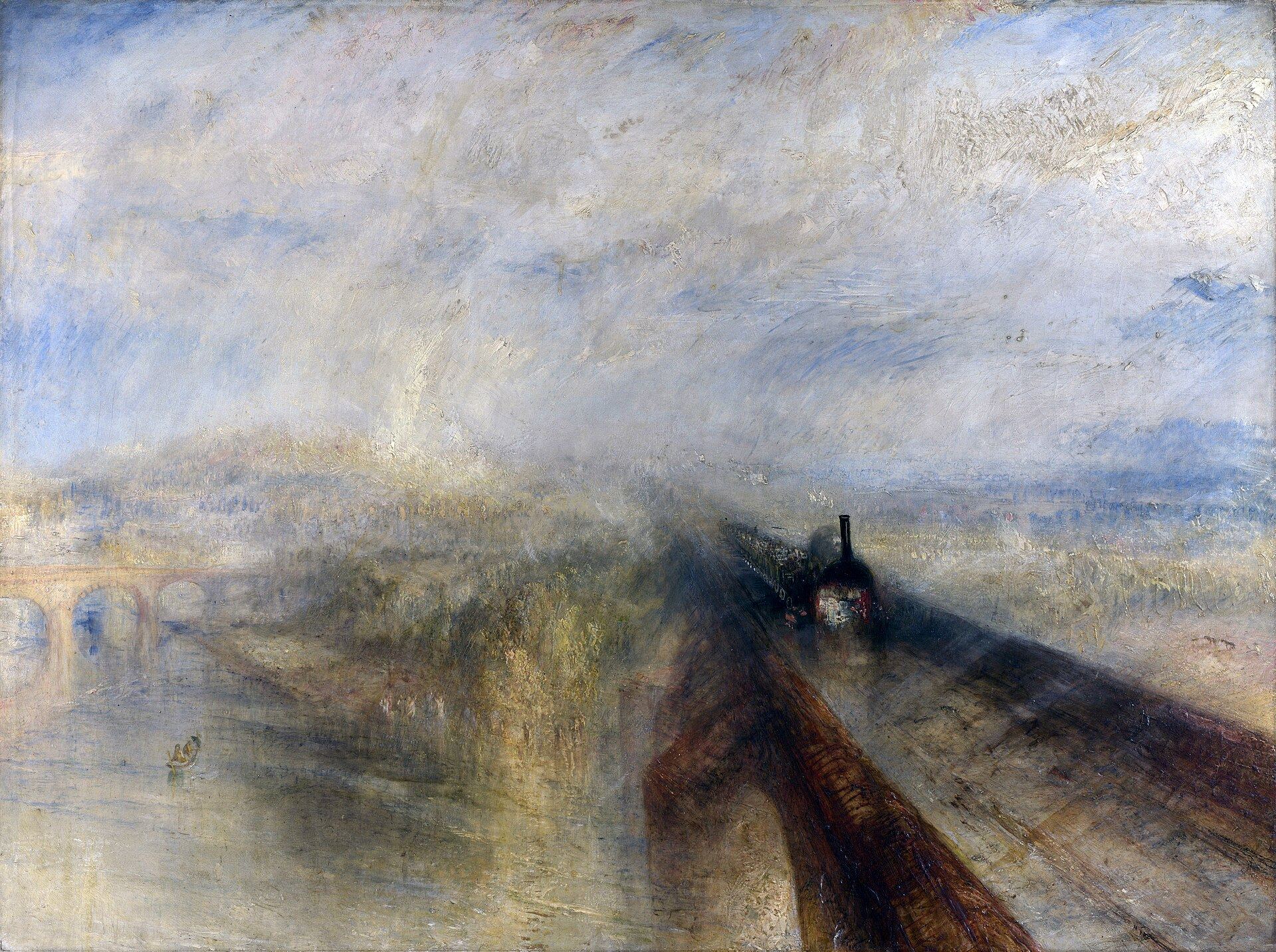
Turner's Rain, Steam and Speed: a dark locomotive rushes out of gold and blue mist across a bridge

Art is
infrastructure.

J.M.W. Turner, Rain, Steam and Speed, 1844

We file art under decoration and entertainment. A century of philosophy and anthropology treats it as a working mechanism of civilisation. I think a society depends on it as much as on roads and laws. It does at least seven jobs.

Seven things art does

These seven are drawn from the work of ten writers on art and society, among them the philosopher , the critic and the anthropologist . Behind them sits a larger claim, made by the historian : symbols and rituals came before tools, and made them possible. All ten sources are set out on their own pages.

This is a thought piece. It points those ideas at a practical question: what would a new society, such as a network state, do differently if it took art seriously? The evidence behind the ideas is uneven, the systems language is analogy, and most real works do several of these jobs at once.

Seeing

Art gives form to what we sense but cannot yet say or measure.

In people

We see what we expect to see. Art gives a shape to feelings that have no words yet, from a painter's canvas to graffiti on a wall, where people say what they can't say anywhere else.

As a system

The metrics can look good while the human side is missing. Dashboards count only what someone has already decided to count, and they can't count how life feels. Art picks up a change in mood before any number does.

Without it

Institutions keep optimising numbers that have stopped meaning anything. They are slow to see what is going wrong, and they miss new possibilities as they start to grow.

A caution. What art picks up is hard to check, and a loud few can be mistaken for the mood of everyone.

Drawing on
, supported by ,
In systems terms
Perceptual and epistemic calibration
Scale it works at
The individual, then the collective
Turner's The Fighting Temeraire: a pale, ghostly sailing warship towed by a small dark steam tug under a burning sunset

Then · 1839

Turner paints the industrial age

Turner painted the feeling of the industrial age before anyone could measure it.

More

The Fighting Temeraire shows a warship of the age of sail hauled to the breaker's yard by a steam tug. Rain, Steam and Speed, at the top of this page, followed in 1844.

Turner had no instrument for what was happening to the air and the pace of life, so he painted the sensation itself. The viewer feels the old world being towed away before any concept such as pollution or acceleration exists to name it.

J.M.W. Turner, The Fighting Temeraire, 1839. National Gallery, London. Public domain. Image source · Further reading

Six memes in a grid: the This Is Fine dog drinking coffee in a burning room; two Wojak figures hugging under the words I know that feel bro; a white alpaca, the Chinese Grass Mud Horse; the Doomer Wojak in a beanie, smoking at night; Meme Man in a suit before a rising stock chart, captioned Stonks; and Pepe the Frog

Now · Online

Memes

A meme spreads because it names a feeling people didn't know they shared.

More

Memes belong to nobody in particular: quick, anonymous, and copied and altered by whoever passes. Most say very little. The ones that travel give a face to a mood that thousands of people recognise in themselves. This Is Fine is an institution insisting all is well while the room burns. I Know That Feel Bro is the moment a private feeling turns out to be shared. The Grass Mud Horse, a pun on a Chinese obscenity, let people mock censorship in words the filters missed. Doomer and Stonks put a face to loneliness and to an ironic distrust of markets.

A meme that lands is a reading of the public mood that no survey asked for, and it comes from below rather than from any institution. Pepe, the last panel, shows the limit: a gentle frog taken over by a loud few, whose use was then read as the mood of far more people.

This Is Fine (after KC Green), I Know That Feel Bro, Grass Mud Horse, Doomer, Stonks and Pepe the Frog (after Matt Furie). Recreated with an image model by the page author. Not openly licensed. Image source · Further reading

Rehearsing

Art is a safe place to try out feelings and futures we haven't lived.

In people

Inside a story you can live through grief, betrayal or collapse and then close the book. You meet feelings your own days haven't brought you, and afterwards you can recognise them in yourself and in other people.

As a system

It's practice. Every story widens a little what a person can feel and cope with, the way engineers run what-if simulations before they build.

Without it

A society that has never practised living with uncertainty tends to meet each new shock by closing ranks.

A caution. The claim that fiction builds empathy rests on mixed evidence. Some studies find an effect and others don't.

Drawing on
,
In systems terms
Counterfactual and behavioural simulation
Scale it works at
The individual, then the social group
Ruins of the Theatre of Dionysus: curved stone tiers around a paved semicircular floor, with Athens beyond

Then · 5th century BCE

Athenian tragedy

Much of the city watched its hardest dilemmas play out on stage before voting on real ones.

More

Athens staged tragedies such as the Oresteia and Antigone at a civic festival in this theatre, below the Acropolis.

Thousands of citizens sat together and watched a dilemma play out to its end with no real blood spilt. Then many of the same people went to the assembly and voted.

Theatre of Dionysus, Athens. Jorge Láscar, CC BY 2.0. Image source · Further reading

EVE Online screenshot: a spacecraft leaves a vast lit station against a dark teal nebula

Now · Online

EVE Online and Dwarf Fortress

Players run economies, wars and funerals where the only thing at risk is time.

More

Simulation games where players run espionage, markets, treaties and even funerals for one another.

These worlds have real scarcity, betrayal and loss of invested time, yet nobody is physically harmed. Players learn how alliances and markets behave under pressure by running them.

EVE Online screenshot. CCP Games, CC BY-SA 3.0. Image source · Further reading

Making special

Art tells a crowd what matters by spending visible care on it.

In people

Rhythm, symmetry and extraordinary craft trigger reverence. Gell called it the technology of enchantment. What a place takes care over tells a visitor what it values, more reliably than a statement on the wall.

As a system

Care is costly to fake, which is why a group's attention settles on it.

Without it

When everything comes from a template or is generated for free, nothing feels as if it matters.

A caution. Visible effort can also dress up something empty. Grand buildings have served bad causes.

Drawing on
, supported by
In systems terms
Salience amplification
Scale it works at
The social group, then civic life
Notre-Dame de Paris from the south: rose window, spire, towers and flying buttresses above the trees

Then · Medieval Europe

The Gothic cathedral

Generations of visible effort told a town what mattered most.

More

Built across generations by craft guilds, combining acoustics, coloured light and stone at a scale no private building approached.

A cathedral is effort made visible. Skilled labour far beyond what shelter requires tells everyone in sight that this place matters more than any private house.

Notre-Dame de Paris, 2017. Ali Sabbagh, CC0. Image source · Further reading

The first web page: a plain white window headed World Wide Web with a short list of hand-written links

Now · Online

The hand-made web

Among identical templates, a hand-made page shows that someone cared.

More

From hand-coded personal sites to Poolsuite and Art Blocks. Shown here is the first web page of all, written by hand at CERN in 1991.

When every page comes from the same template, a hand-made one reads instantly as cared for. It shows that a person spent time here, and people give time back.

The first website, CERN, 1991. Tim Berners-Lee / CERN. Public domain. Image source · Further reading

Moving together

Art aligns separate people into joint action without anyone giving orders.

In people

Shared rhythm and song bring bodies into step and lower the sense of threat between strangers.

As a system

It creates what game theorists call a Schelling point: something everyone can rally to without being told. Shared symbols let each person see that the others are committed too.

Without it

People with the same interests can't find each other, because they share no symbols.

A caution. The same mechanism powers propaganda rallies.

Drawing on
supported by , ,
In systems terms
Collective coordination and synchronisation
Scale it works at
The social group, up to a whole civilisation
Tallinn Song Festival Grounds: a vast arched shell filled with a massed choir, facing a crowd that fills the field

Then · 1987 to 1991

Estonia's Singing Revolution

Singing banned songs together showed a nation that it wasn't alone.

More

Under Soviet rule, hundreds of thousands gathered on these grounds to sing forbidden songs. The photograph is from the 2009 festival on the same site.

A voice in a choir is a public commitment that everyone around you can hear. Once a crowd that size sings the same forbidden song, each person knows that the others want the same thing, and knows that the others know it too.

Tallinn Song Festival Grounds, 2009. ToBreatheAsOne (Egon Tintse), CC BY-SA 2.0. Image source · Further reading

The r/place canvas: thousands of pixel-art flags, faces, logos and murals packed edge to edge, with a large multicoloured protest slogan on the right

Now · Online

r/place

Millions of strangers organised themselves around pictures on a shared canvas.

More

Given a shared pixel canvas and a cooldown timer, millions of strangers formed factions, negotiated borders and defended murals. The picture is a screenshot of the finished canvas.

No one assigned territories. A recognisable image on the canvas became a focal point, strangers rallied to defend it, and diplomacy followed.

Screenshot of the r/place canvas. Supplied by the page author. Not openly licensed. Image source · Further reading

Breaking the spell

Art tests the dominant story and shows where the consensus is weak.

In people

Satire, estrangement and juxtaposition make the familiar strange, so unspoken assumptions become visible.

As a system

It's red-teaming for a culture. A red team is the group asked to attack its own side's plans in order to find the flaws. Artists do this to a society's norms before reality does.

Without it

A society that suppresses or co-opts its critics loses its main defence against groupthink.

A caution. Critique can be absorbed as a style, or harden into a cynicism that tests nothing.

Drawing on
supported by , , ,
In systems terms
Adversarial stress-testing and subversion
Scale it works at
Civic life, up to a whole civilisation
Black and white photograph of a gallery crowded with satirical posters and montages, a uniformed dummy hanging from the ceiling

Then · 1916 to 1930s

Dada and Heartfield's photomontage

Cut-and-paste images exposed what propaganda wanted people to accept without question.

More

The First International Dada Fair, Berlin, 1920. John Heartfield went on to turn photomontage against Weimar and Nazi propaganda.

Photomontage cuts images out of the context that makes them feel natural and joins them where they don't belong. The seam forces the viewer to notice what the original asked them to accept.

Opening of the First International Dada Fair, 1920. Unknown photographer, Dada Almanach. Public domain. Image source · Further reading

Diagram: a beagle photo plus a square of coloured noise equals an identical-looking photo that a classifier labels ostrich with 99 per cent confidence

Now · Online

Adversarial patches and MSCHF

Small patterns that fool a machine show the public where it fails.

More

Artists and researchers build patterns that blind machine vision, and collectives like MSCHF stage stunts that make a technology's purpose uncomfortable. Shown: invisible noise that turns a beagle into an ostrich for a classifier.

These works find where a system's assumptions fail and stage the failure in public, so the system's owners and the people it watches can both see where it breaks.

Adversarial perturbation illustration. Joshuaclymer, CC BY-SA 4.0. Image source · Further reading

Remembering

Art packs lived experience into forms that survive the generations.

In people

A memory that lives only in talk lasts three or four generations and then is gone. Songs, buildings and stories lodge in feeling as well as fact, and later minds can rebuild what they carried.

As a system

A song or a monument stores decades of experience in a small form, a little like a compressed file. Some detail is lost, but it can still be unpacked centuries later.

Without it

A community that never turns its living memory into lasting forms loses it within a lifetime, and has to relearn its worst mistakes from scratch.

A caution. What gets kept is chosen, by people with interests in the present. Songs and monuments survive when they suit those who keep them.

Drawing on
supported by ,
In systems terms
Cultural compression and state preservation
Scale it works at
A whole civilisation, across generations
The twin hulls and rigging of the voyaging canoe Hōkūle‘a, moored on turquoise water

Then · Oral traditions

Wayfinding chants and griot song

Navigation and history survived for centuries as song, because people can hear when a song sounds wrong.

More

Polynesian navigators and West African griots held star paths, genealogies and precedent in metred song. Shown: Hōkūle‘a, the canoe built in 1975 to sail by traditional navigation.

Metre and melody limit what the next word can be, so a singer who misremembers hears the mistake.

Hōkūle‘a. Tonitt, CC BY-SA 3.0. Image source · Further reading

Frame from a demoscene intro: a glowing blue-white spiral galaxy with small dark planets

Now · Online

The demoscene

Programmers compete to fit a whole animated film, with music, into a file smaller than a single photo.

More

The demoscene is a community of programmers who make short animated films with music, as a craft and as a competition. The catch is size. The whole work must fit in a tiny file, sometimes 64 kilobytes and sometimes only 4. Shown: Beyond by Conspiracy, 2004, a 64-kilobyte work.

A file that small can't store pictures or sound. It stores the instructions for making them, and the computer rebuilds the film each time it runs. Knowledge is kept as a recipe, which is also how a song keeps a route across the sea.

Beyond, Conspiracy, 2004. Gargaj, CC BY-SA 2.5. Image source · Further reading

Being seen

Making art lets a person, and a community, feel that they exist to others and can act.

In people

Giving pain or joy a form outside yourself makes it easier to carry. It also says something to others, and having it received tells you that you count.

As a system

Making and showing things is how members tell each other, and newcomers, who they are and what they value. A visitor understands a place through what its people make.

Without it

People feel unseen and powerless. They withdraw, or they leave without ever having spoken.

A caution. Research on the arts and wellbeing is broad, but it mixes strong trials with small pilots. Being seen by a community can also become pressure to conform, and Berger showed how being looked at can turn a person into an object.

Drawing on
, , supported by , ,
In systems terms
Expression and recognition
Scale it works at
The individual, then the community
A table covered with small, brightly coloured stitched tapestries showing houses, mountains and rows of figures

Then · 1974 to 1990

Chilean arpilleras

Women stitched their grief and their accusations into cloth, and found each other doing it.

More

Under Pinochet, women whose relatives had been disappeared met in church-run workshops to sew small tapestries on sacking, sometimes using cloth from the missing person's clothes. The works were sold abroad and carried news of the regime with them. The photograph shows arpilleras on display; the date and makers of these particular pieces are not recorded.

Making the tapestry did something for the maker before it did anything for an audience. It gave grief a form, put her in a room with others who shared it, and turned a private loss into public testimony.

Arpilleras. Ministerio de Relaciones Exteriores, Gobierno de Chile, CC BY 3.0. Cropped. Image source · Further reading

A pink map of central London crowded with black pins. One pin is open, showing an anonymous note about coming out to a friend under a tree before an exam

Now · Online

Queering the Map

Anonymous notes pinned to a shared map tell people that someone like them was here.

Explore the map ↗

More

Launched in 2017 by Lucas LaRochelle, the site lets anyone pin a queer memory to the place where it happened, with no name attached. The screenshot shows London.

Each pin is one person saying that this happened to them, here. Read together, the pins tell a visitor that they aren't alone and that lives like theirs leave a mark on the world. No one curates it, so the recognition comes from peers.

Screenshot of Queering the Map, showing London. Not openly licensed. Image source · Further reading

What this could look like in a network state

A cultural layer in the network state stack

The larger aim is a playbook that any startup society could pick up and run.

It would let a new society build its culture on purpose, as it builds governance or a treasury: a quick way to find which of the seven jobs a community neglects, tested experiments for each job, the roles and budget lines that keep them going, and a common way to measure and report. What works in one startup society could then be set up in the next.

Each idea below is an experiment to try, not a proven method, and most could work online or in person. Where something like it has already shown up at a pop-up city or network school, it's noted under the heading. Those notes come from published accounts and from members. I haven't been to these places myself.

Seven places to start

The playbook would start from experiments like these, one set for each job.

01

Seeing

A shared canvas the founders read, an artist reporting to governance, and a yearly exhibition of how the community feels.

  • A shared canvas, physical or online, that any member can add images, memes and graffiti to, and which the founders read as seriously as the metrics.
  • An artist in residence attached to the governance team, asked to report what the dashboards miss.
  • A yearly exhibition of how the community feels, shown alongside the financial report.

Read chapter 1

02

Rehearsing

Game out a rule before voting on it, commission fiction about the community's future, and argue the side you oppose.

  • Play a proposed rule as a game or a story before voting on it.
  • Commission fiction set ten years into the community's future, including the versions where it fails.
  • Hold sessions, online in text or voice, where members argue the side they oppose.

Already seen. Edge City Patagonia in 2025 advertised Governance Games, live simulations of new ways to coordinate. I haven't found a report on what they changed.

Read chapter 2

03

Making special

Member-made objects for founding moments, one place built with more care than it needs, and membership tokens made by artists.

  • Mark founding moments with objects made by members' hands.
  • Build one shared place, a hall, a garden or a digital equivalent, with more care than it strictly needs.
  • Have member artists make the tokens of membership.

Already seen. Someone who has been at Network School, on wishing for literal art on the walls there: 'no one disagreed with me. Everyone felt the need for more culture.' (chrislarsc, on Farcaster)

Read chapter 3

04

Moving together

A regular moment of making together, a tune or meme of the community's own, and a shared mural at every gathering place.

  • Keep a regular moment when everyone makes something at the same time, across time zones.
  • Let a theme tune, jingle or meme become the community's own.
  • Paint a shared mural at every gathering place.

Already seen. At Zuzalu in 2023, Vitalik Buterin reports that a daily cold plunge grew up on its own and karaoke nights began after a month.

Read chapter 4

05

Breaking the spell

Satire the founders can't veto, a yearly evening of public mockery, and a prize for the best critique.

  • Fund satire of the project that the founders cannot veto.
  • Hold a yearly evening where the community's assumptions are mocked in public.
  • Give a prize for the best critique.

Read chapter 5

06

Remembering

Lasting forms for founding memories, an archive members add to each year, and failures marked as carefully as successes.

  • Decide early which memories must outlive the founders, and give each one a form: a song, a festival, a place.
  • Keep an archive made as art, where each year's members add a panel.
  • Mark the failures as carefully as the successes.

Read chapter 6

07

Being seen

A space for every member to make and show work, a shared map of memories, and a welcome that receives what newcomers make.

  • Give every member a page or space of their own, to make and show their work.
  • Start a shared map where members pin their memories of the community's places.
  • Ask each newcomer to make something, and have the community receive it.

Already seen. Zuzalu asked residents to host their own parties, workshops and talks. At Network School, according to chrislarsc, who has been there, members put on voice lessons, monthly performances, stand-up comedy nights and dance classes. Edge City runs Art on the Edge, a residency for 10 to 15 artists.

Read chapter 7

Where this goes next

Every society gets these seven jobs done somehow: by accident or on purpose.

Taking art seriously means planning for all seven with the same intent you bring to governance and code. Older nations inherited these mechanisms over centuries; a new society has to build them from scratch.

The next step is to test this with a real community and publish what happens. If you're building a startup society, or already doing some of this, I'd like to hear from you: ChrisCoCreated on Farcaster.

← Back to the essay · All sources

English philosopher and historian, 1889 to 1943

R.G. Collingwood

The Principles of Art, 1938 · The New Leviathan, 1942

Amusement, magic, art proper

Collingwood set out to say what art is by first clearing away what it is mistaken for. Craft is skill applied to a planned end. Amusement arouses emotion in order to discharge it harmlessly. Magic, in his special sense of the word, arouses emotion in order to direct it into the work of life: the war dance before the battle, the work song, the wedding.

Art proper is different from all three. A person begins with a feeling they cannot yet name, and by finding a form for it they come to know what they feel. Expression, for Collingwood, is a kind of discovery. In his view, you don't know exactly what you feel until you've said it.

He drew a social conclusion from this. A community that cannot be honest about its own feelings suffers what he called a corruption of consciousness. The artist's task is to tell an audience the truths about itself that it has not yet faced.

What each chapter takes from Collingwood

Not used as a source for Rehearsing, Making special or Remembering.

Where I go further than Collingwood

Collingwood ranked art proper above magic and amusement, and would not have called all three art. I treat them as equally useful jobs. He did see art as essential to saving a civilisation from self-deception, and he cast the artist as a truth-teller to the community, where I talk about designing shared practices. He also held that a work of art is first an act of imagination, and gave less weight than I do to the physical making.

Further reading on R.G. Collingwood ↗

← Augusto BoalHerbert Read →

← Back to the essay · All sources

English poet, critic and anarchist, 1893 to 1968

Herbert Read

Art and Society, 1937 · Education through Art, 1943 · Icon and Idea, 1955

Image before idea

Read spent his career arguing that art is a basic human activity. In Icon and Idea he proposed that the image comes before the idea. People grasp something first as a made form, a mark or a figure, and only later as a concept that philosophy or science can state.

In Education through Art he argued that making art should be the foundation of schooling, because it is how a child's feeling and perception grow together. He held that every person is a kind of artist, and wanted everyone to be a maker and not only an audience.

Read was an anarchist of a constructive kind. He put his faith in education and making, and not in polemic. He believed that a society of people who create freely is harder to regiment, and he set creative freedom against the conformity he saw in the dictatorships of his time.

What each chapter takes from Read

Not used as a source for Rehearsing, Making special, Moving together or Remembering.

Where I go further than Read

Read's claim that the image always comes before the idea is a grand theory about prehistory that archaeology cannot confirm. I use it as a way of looking, not as established fact.

Further reading on Herbert Read ↗

← R.G. CollingwoodRaymond Williams →

← Back to the essay · All sources

Welsh writer and critic, 1921 to 1988

Raymond Williams

Culture and Society, 1958 · The Long Revolution, 1961 · Marxism and Literature, 1977

Structure of feeling

Williams insisted that culture is ordinary. It is the whole way of life of a people, and the arts are one part of it, not a separate realm for the educated.

His best-known idea is the structure of feeling: the particular quality of life in a time and place, as it is lived before anyone has turned it into doctrine. He thought the art of a period is where this shows first, because artists work with experience that has not yet been named.

He also described the selective tradition. Each generation keeps part of what earlier ones made and discards the rest. The choosing is done by people with interests in the present, so what survives of a culture tends to confirm the order that selected it. And he separated the dominant culture from the residual and the emergent, meaning older values still active in the present and new ones arriving. He warned that the dominant culture works to absorb the emergent as soon as it gains ground.

What each chapter takes from Williams

Not used as a source for Rehearsing, Making special, Moving together or Being seen.

Where I go further than Williams

Williams wrote as a socialist analysing class and power in Britain. I borrow his terms for a different project, and he might well have been sceptical of it.

Further reading on Raymond Williams ↗

← Herbert ReadJohn Berger →

← Back to the essay · All sources

English critic, novelist and painter, 1926 to 2017

John Berger

Ways of Seeing, 1972, a television series and a book

Mystification

Berger's starting point is that seeing is never innocent. What we see is shaped by what we know and believe, and images are made by people with interests.

He used the word mystification for the way talk about art can hide what a picture shows about power. The European oil painting, he argued, was often a celebration of ownership: of land, of goods and of livestock. In a separate argument he showed how the European nude displayed women for a male spectator who was assumed to own the view. Modern advertising inherits its language and uses it to make viewers dissatisfied with their lives.

Drawing on Walter Benjamin's essay on art in the age of mechanical reproduction, his method was to take images out of their reverent settings and set them beside others, so that a viewer could see how they work. The series was itself an example of the criticism it described.

What each chapter takes from Berger

Not used as a source for Rehearsing, Moving together or Remembering.

Where I go further than Berger

Berger wrote from a Marxist position and aimed at capitalism in particular. I use his method as a general tool, one that any society, including a new one, should expect to have turned on itself.

Further reading on John Berger ↗

← Raymond WilliamsBrian Eno →

← Back to the essay · All sources

English musician, producer and artist, born 1948

Brian Eno

John Peel lecture, 2015 · What Art Does, with Bette Adriaanse, 2025

Adult play

Eno starts from a plain definition: art is everything you do not have to do. We have to eat, but we do not have to invent cuisines. We have to move, but we do not have to dance. He locates art in that extra.

He asks why people spend so much effort on it, and his answer is play. Children play to learn how the physical and social world works. Adults carry on through art, where they can try out feelings, other people's points of view and whole imagined worlds without the cost of living them.

The idea that art grows out of play has a long history. Schiller wrote of a play drive in the 1790s, and Johan Huizinga made play the root of culture in Homo Ludens in 1938. Eno puts the idea in plain words for a general reader.

He also thinks about art as something groups do. In his Peel lecture he suggested that shared culture helps people stay in step with one another as the world changes. And he coined the word scenius for the intelligence of a whole creative scene, as opposed to the lone genius: good work comes out of groups of people who watch, copy and encourage one another.

What each chapter takes from Eno

Not used as a source for Seeing, Making special, Breaking the spell or Remembering.

Where I go further than Eno

Eno calls art the things we do not have to do, and this essay calls it infrastructure. The two fit together only at different scales. What is optional for one person's survival can be load-bearing for a society. Eno is also a working artist thinking aloud, and he says so. His account is a persuasive description and has not been tested as a theory.

Further reading on Brian Eno ↗

← John BergerEllen Dissanayake →

← Back to the essay · All sources

American scholar of art and human evolution

Ellen Dissanayake

What Is Art For?, 1988 · Homo Aestheticus, 1992 · Art and Intimacy, 2000

Making special

Dissanayake treats art as something people do, a behaviour, and asks why it evolved. Her answer is making special, which she later called artification: the universal habit of taking ordinary things, such as movements, sounds, words and objects, and elaborating them with pattern, repetition, exaggeration and care.

People make special what matters to them: births, deaths, harvests, dangers. The elaboration marks an occasion as important, makes it memorable, and draws a group's attention and feeling toward it together. She argues that communities which did this held together better, so the habit was passed on.

In later work she traces the habit back to the earliest bond, the rhythmic and exaggerated exchange between a mother and an infant. From this she argues that art answers needs for belonging, meaning and competence.

What each chapter takes from Dissanayake

Not used as a source for Seeing, Rehearsing or Breaking the spell.

Where I go further than Dissanayake

Evolutionary accounts of art are hard to test, and hers is one of several. I rely on her description of what people do more than on her explanation of why.

Further reading on Ellen Dissanayake ↗

← Brian EnoAlfred Gell →

← Back to the essay · All sources

British social anthropologist, 1945 to 1997

Alfred Gell

The Technology of Enchantment and the Enchantment of Technology, 1992 · Art and Agency, 1998

Technology of enchantment

Gell wanted an anthropology of art that did not depend on beauty or meaning. He proposed looking at what art objects do. An artwork, in his account, is something that makes people sense an agent behind it: a maker, a patron, a spirit, a power.

His example is the carved prow-board of a Trobriand trading canoe. Its dazzling pattern is meant to unsettle trading partners so that they part with their valuables more easily. The viewer cannot work out how it was made, and that bafflement at another person's skill is the enchantment.

Art for Gell is a technology. It is a way of acting on other people through objects, and of extending a person's influence beyond their own body.

What each chapter takes from Gell

Not used as a source for Seeing, Rehearsing, Moving together, Remembering or Being seen.

Where I go further than Gell

Gell treated enchantment mainly as a way of gaining advantage over other people. I adapt it toward shared attention, and the caution in our chapter keeps his warning.

Further reading on Alfred Gell ↗

← Ellen DissanayakeLewis Mumford →

← Back to the essay · All sources

American historian of technology and cities, 1895 to 1990

Lewis Mumford

Technics and Civilization, 1934 · Art and Technics, 1952 · The Myth of the Machine, 1967

Symbols before tools

Mumford spent his life writing about machines and cities, and came to distrust the story that tools made us human. In The Myth of the Machine he argued that early people put far more effort into ritual, language, dance and ornament than into tools, and that this work on the mind came first.

In Technics and Civilization he had already shown that the machine age was prepared by culture. He named the clock, not the steam engine, as its key machine, and traced it to monks who needed to keep their hours of prayer. A ritual taught Europe to live by the clock long before any factory needed it.

He also saw the danger of a society that perfects its machines and neglects its inner life. He coined the word megamachine for vast organisations that use people as their parts, and in a 1964 essay he set such authoritarian technics against democratic technics, which stay small in scale and under local control. In Art and Technics he argued that art is where a technical civilisation keeps its sense of what the machines are for.

What each chapter takes from Mumford

Not used as a source for Seeing, Rehearsing, Making special, Breaking the spell, Remembering or Being seen.

Where I go further than Mumford

Mumford's account of prehistory is a bold interpretation that goes beyond what archaeology can strictly prove. He was also a critic of large technical systems, and would have had hard questions for a project like a network state. His own distinction suggests the test he would apply: whether it stays human in scale and governed by its members.

Further reading on Lewis Mumford ↗

← Alfred GellJan and Aleida Assmann →

← Back to the essay · All sources

German scholars of memory. Jan Assmann, Egyptologist, 1938 to 2024. Aleida Assmann, literary scholar, born 1947

Jan and Aleida Assmann

Jan Assmann, Cultural Memory and Early Civilization, 1992 · Aleida Assmann, Cultural Memory and Western Civilization, 1999

Cultural memory

The Assmanns begin from a simple observation. What people tell each other about the recent past is one kind of memory. It needs no specialists and no institutions, and it fades as the people who hold it die, after eighty years or so. They call this communicative memory.

Cultural memory is different in kind. It reaches back beyond anyone's lifetime, to founding events and origins, and it has to be made. It is fixed in rituals, festivals, images, buildings and canonical texts, and it stays alive only while those are performed again and again. It is looked after by people whose job that is. Jan Assmann called it the connective structure of a society: the thing that binds its members to one another and to their past.

Aleida Assmann added a distinction between what a culture keeps in active use and what it only stores. The canon is what is performed, taught and displayed. The archive is what is kept out of circulation, from which a later generation can recover things it needs.

What each chapter takes from the Assmanns

Not used as a source for Seeing, Rehearsing, Making special, Moving together, Breaking the spell or Being seen.

Where I go further than the Assmanns

Jan Assmann's main cases were civilisations thousands of years old, above all ancient Egypt. Aleida Assmann writes mostly about modern European memory. By their own definition a community a few years old still lives entirely in communicative memory, because everyone who saw its founding is there to talk about it. I use their terms to ask a question they did not: whether such a community can start building cultural memory on purpose, before its founders are gone.

Further reading on Jan and Aleida Assmann ↗

← Lewis MumfordAugusto Boal →
← Back to the essay · All sources

Brazilian theatre director and writer, 1931 to 2009

Augusto Boal

Theatre of the Oppressed, 1974 · The Rainbow of Desire, 1995

The spect-actor

Boal made theatre in Brazil under a military regime that arrested and tortured him in 1971 and sent him into exile. He came to think that ordinary theatre trains people to be passive. The audience watches others act, feels strongly, and goes home unchanged.

His answer was the Theatre of the Oppressed. He took theatre out of the playhouse and into streets, trains and workplaces, sometimes without telling bystanders that what they were watching was a play, which he called invisible theatre. A different form, forum theatre, is the best known. A short play shows a real problem from the community's own life and ends badly. It is played again, and this time anyone watching may stop it, step into the role of the person facing the problem and try a different course. Nobody may replace the oppressor, because that would solve the problem by wishing. Boal called these people spect-actors. He owed much to the educator Paulo Freire.

Later, as a city councillor in Rio de Janeiro, he used the same method to ask residents what laws they wanted. He called it legislative theatre, and thirteen of its forty proposals became law.

What each chapter takes from Boal

Not used as a source for Seeing, Making special, Moving together, Breaking the spell or Remembering.

Where I go further than Boal

Boal made his theatre for people resisting oppression, and meant it as preparation for political change. I use it more broadly, as a way for any community to try out its own rules. He made a similar move himself in his later work in Europe, where he turned the method on habits people carry inside them, which he called the cop in the head.

Further reading on Augusto Boal ↗

← Jan and Aleida AssmannR.G. Collingwood →

← Back to the essay

The work so far

Six pieces made on Farcaster since 2023, each doing one or more of the seven jobs. They were made as art, before this essay existed. Read together, they are an early record of what these jobs look like in an online community.

A square mosaic of dozens of small images, many purple, arranged in the shape of the Farcaster arch, with FarCon Boston 2023 in the corner

Boston, 2023

FarCon workshop

Jobs: Moving togetherMaking specialRemembering

At the first FarCon, I ran a workshop where everyone in the room made one artwork together. It began with a conversation about what people valued about Farcaster and how they would describe its personality, and each person's contribution grew from that. The contributions were gathered through a Farcaster client and assembled into a single piece, which was minted as an NFT for everyone who took part. The session ended with a WeCast of everyone in the room.

Why it fits. A community that mostly knew each other through the feed made one thing together in a single sitting, and each of them took home a share of it. The piece is a souvenir of the first FarCon and a record of who was there.

See the work ↗

A blended photograph in which two images merge into one layered, colourful scene

2024

Photosynthesis

Jobs: Making specialBeing seen

A generative photography collection made with photographers from the Farcaster community. Their photographs are blended in pairs, and of about 25,000 possible combinations only around 2,222 will exist, chosen one at a time by collectors. Every work carries the names of its two photographers and the collector who chose it. Two-thirds of the revenue goes to the photographers.

Why it fits. Collectors decide which images deserve to exist, so choosing becomes the craft. And everyone who made a work is named on it, including the person who chose it.

See the work ↗

A pale lilac collage of the community's posts, memes, photographs and purple circles, with a small stepped purple tower near the bottom

2023, unfinished

The Scenius Spire

Jobs: SeeingMaking specialRemembering

The foundation of a larger piece, made for and with the Farcaster community to celebrate the scenius happening there. It gathers the community's own posts, memes and pictures into one image. The spire itself was never finished.

Why it fits. It showed the community to itself as a scene, a body of shared jokes and ideas, at a time when few people described it that way. It also keeps a record of the scene in its early days, its posts, jokes and pictures, in one place. Unfinished as it is, it points to what a fuller version could do.

See the work ↗

A Mona Lisa built from tiny names, in a gold frame

2025

We Are The Art

Jobs: Being seenMoving togetherRemembering

A year-long onchain experiment in which the community became the art. Each month's work was decided in conversation with collectors and generated from their onchain names, from We Are Mona Lisa to We Are WoWoW.

Why it fits. Members were both the subject and the deciders. Each month they chose what to make, and found their own names in the result.

See the work ↗

Two heads drawn in text leaning together, one in pink made of the name j-valeska, one in green made of chriscocreated

2024, with J. Valeska

Onchain Hugs

Jobs: Making specialBeing seen

A pair of NFTs that two people create together to mark a friendship. One person picks the colours and sends a hug through a Farcaster frame. When the friend accepts, both receive a matching, unique token. It runs on a small protocol we called Proof of Friendship.

Why it fits. It turns an ordinary gesture into a lasting, visible mark of a relationship. It also bears on belonging.

See the work ↗

WeCast Network State: a waving purple flag with a cross, made of tiny usernames, with a magnified circle showing names like chriscocreated and frdysk

WeCast Network State, made from everyone who opted in

2023 to 2026

WeCast

Jobs: RememberingMoving togetherBeing seen

A long-running series that marks significant moments on Farcaster by making an artwork from the people present. It began with the 2,000 or so most active casters, and has since included Pro members and 49,000 Warplets. The latest, WeCast Network State, commemorates the founding of the Farcaster Network State: anyone who liked the cast opted in, appears in the piece, and could mint it for free.

Why it fits. Each piece is a census of a community at a moment in its history, and the people in it chose to be counted. Over time the series becomes an archive of the network's turning points, with names in it.

See the work ↗

All six against the seven jobs

Main job Also does

None of the six does Rehearsing or Breaking the spell.

← Back to the essay

R.G. Collingwood · English philosopher and historian, 1889 to 1943

Amusement, magic, art proper

Collingwood separated three things we call art. Amusement distracts. Magic channels shared emotion into the work of a community. Art proper turns a feeling that has no words yet into self-knowledge.

Full page on Collingwood

Herbert Read · English poet, critic and anarchist, 1893 to 1968

Image before idea

Read argued that people make symbols before philosophy, law or science can turn them into concepts, so art comes first. He also saw widespread creative freedom as a defence against authoritarian conformity.

Full page on Read

Raymond Williams · Welsh writer and critic, 1921 to 1988

Structure of feeling

The lived mood of a generation, present before it hardens into institutions or ideology. Williams saw art as the place where that mood first becomes visible.

Full page on Williams

John Berger · English critic, novelist and painter, 1926 to 2017

Mystification

Berger showed that images are never neutral. They can hide who holds power, as advertising does, or expose it.

Full page on Berger

Brian Eno · English musician, producer and artist, born 1948

Adult play

Eno defines art as everything you do not have to do. Children play to learn how the world works. He sees art as the way adults carry on, safely trying out feelings, other minds and possible futures.

Full page on Eno

Ellen Dissanayake · American scholar of art and human evolution

Making special

Dissanayake describes the human habit of elaborating what matters, with pattern, repetition and care, so that others treat it as important. She regards it as an evolved need.

Full page on Dissanayake

Alfred Gell · British social anthropologist, 1945 to 1997

Technology of enchantment

Gell treated art objects as things that act on people. Skill we cannot account for captivates us, and that captivation is a form of social power.

Full page on Gell

Lewis Mumford · American historian of technology and cities, 1895 to 1990

Symbols before tools

Mumford argued that humans were makers of symbols, rituals and language before they were makers of tools, and that this inner culture is what made complex technology and cities possible.

Full page on Mumford

Jan and Aleida Assmann · German scholars of memory. Jan Assmann, Egyptologist, 1938 to 2024. Aleida Assmann, literary scholar, born 1947

Cultural memory

The Assmanns separate living memory, which lasts three or four generations, from cultural memory, which a society builds into rituals, monuments and texts so that it can last for centuries.

Full page on the Assmanns

Augusto Boal · Brazilian theatre director and writer, 1931 to 2009

The spect-actor

Boal turned spectators into actors. In his forum theatre, members of the audience step into a scene of injustice from their own lives and try out ways to change it. He saw theatre as a rehearsal for real action.

Full page on Boal